Posts

A sketch of Shah Abdul Karim Boyati's life and philosophy

Image
The 13th show of Mohajoner Nau has been staged at the Experimental Hall of Bangladesh Shilpakala Academy. The stage performance left the audience mesmerised through out the 85-minute duration of the show. The 20 or so performers did a fantastic job of captivating the audience by singing and dancing to the live folk songs. It is a musical play based on the life of the legendary Shah Abdul Karim Boyati who has composed over 1600 Bangla baul songs. Mohajoner Nau was staged in the round or arena theatre more commonly known as the central stage with no curtains. As a result the audience feel very close to the performers in this kind of theatre. The performers walk in and out of the stage from among the audience. The play was written by Shakoor Majid, the famed writer of Londoni Konya, a television drama based on a Sylheti girl living in London, whom everybody wanted to marry in order to get a British passport created a lot of controversy. Although he had written a few dramas and telefilms t...

Translation of Cease Fire from Selina Hossain's Fugutive Colours

Ceasefire Taherun asked her husband, "What are you doing, Bir Pratik Nuruddin? Are you ready to have your lunch now?" "What have you prepared?" "Lafa greens and shidol bhorta, mashed dried fish." "Yes, I'll eat now. Serve the rice." Nuruddin's face brightened at the thought of food. He smiled with a childlike enthusiasm. It was hard to imagine this man as a fierce freedom fighter. From all around, the villagers came to see him when he returned home a victorious hero. People were overwhelmed by his achievements. He was awarded the title of "Bir Pratik." Everyone started addressing him as "Bir Pratik Nuruddin." Gradually everyone except Taherun gave up calling him by that name. Now and then she called him "Bir Pratik Nuruddin" to remind him of his glorious past. He felt both joy and pride at this. He was a poor man. He didn't have much to pride in, no money, no wealth. His honour was his only asset. The mem...

An interview of Dr Anwara Syed Haq published in Star Literature page on 4th Sep 10.

Image
Anwara Syed Haq is a prominent writer in the realm of Bangla literature. She began writing short stories in her teens. This year she won the Bangla Academy Shahitya Puroshkar for her outstanding contributions in the literary world. She was born in 1940 in Jessore, where she spent her adolescent years. She obtained her MBBS degree in 1965 and in 1973 went to the United Kingdom for higher education. She returned home in 1982. She has since then worked at a number of institutions, among which are Bangladesh Biman, Dhaka Medical College and BIRDEM. Even though she works professionally as a psychiatrist, her presence in the literary arena has always been very pronounced. So far she has written more than fifty books. She has been awarded the Annanya Shahitya Puroshkar, Agrani Bank Puroshkar, Michael Madhushudhon Puroshkar and Shishu Academy Puroshkar, besides a host of others. Recently the writers' group Gantha, initiated by Prof Niaz Zaman, accorded a reception to the eminent writer. On...

The Tales of the Neglected: A book review by Jackie Kabir

Image
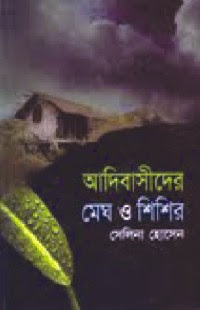
Adibashider Megh O Shishir is a collection of four short stories, four essays, a novella for children and a travelogue, all of which are written on the backdrop of adivashi lives. There are numerous characters, real and imaginary that the author depicts with utmost sincerity. The first story, Bonobhumi, is about an indigenous girl who was kidnapped by the army living in the hill tracts of the southern area of Bangladesh. The same people in the area abused her mother when she was only ten years old. Chandana would vent out against their wrongdoings in her diary everyday, and revolt by supporting the anti-government candidate in the election. She knew that her mother was raped brutally in the jungle, even despite her father's protests. He burnt the boot of the rapist, which he had left behind in a hurry. As such, the bootlace becomes a symbolic rope for the eventual hanging of the hill-tract girl. The lieutenant of the camp nearby was interested in Chandana. However she despised him ...
Image
Aunt and niece’s war with pens Jackie Kabir William Darlymple has perhaps rightly commented that if there is anyone born to write Bhutto family’s story, it is Fatima Bhutto. Songs of Blood and Sword, published by Penguin and Viking, is a sad but un-putdownable work which is a memoir. Fatima is the granddaughter of Zulfiker Ali Bhutto, Pakistan’s first democratically elected Prime Minister - ousted by General Zia to be imprisoned and finally hanged in 1997. She is also the niece to the first female prime minister in the Muslim world, Benazir Bhutto, assassinated in 2007. The writer lost both her uncle and her father in 1985 and 1996 respectively. As I was devouring through the pages with eagerness I couldn’t help remembering yet another book with similar backgrounds written by Fatima’s aunt Benazir, The Daughter of the East an autobiography. Some of the episodes from the books were like looking at the same picture from different angles. Fatima was barely in her teens when her father wa...

Divided loyalties, betrayed love Jackie Kabir reflects on a complex tale of 1971

Image
Kartography is a book about Karachi, the spider plant city where you might find, according to the narrator, fossilized footprints of Alexander the Great. It is a heartbreaking love story, depicts the ethnic conflict which pervades Pakistani society and yet at the same time the resilience of its people. The story revolves around four friends and their lives in Karachi during 1971, which they call the 'Civil War'. The couples Zafar and Maheen, Yasmin and Ali swap their partners. While they handle the situation somehow, it is their children who can't accept the fact that one of their parents had betrayed the other. Karim and Raheen were friends from the time they were born. Karim's parents get separated and somehow he can never get over the situation. His main aim in life is to become a cartographer and give names to the places in Karachi 'where the streets have no name'. Both Karim and Raheen are fascinated by the city of their birth and they keep coming back to i...

For the Love of Writing

Image
A voracious reader and passionate writer, Mahmud Rahman's short stories have been published in magazines and anthologies in the US, UK, Pakistan, India and Bangladesh and recently his first collection of short stories Killing The Water – long-listed for Frank O’Connor Prize - was published by Penguin. Of the 12 stories five are set in the backdrop of Bangladesh and the Liberation War. Growing up in Bangladesh and later living in the US for many years Mahmud's writing covers a varied landscape. On his recent visit to Dhaka he talks to Jackie Kabir about his writing and the reasons behind the subjects he chooses to write on. What inspires you to write? Did the urge to write begin early in life? Sitting down at a keyboard feels like something I have done forever. When I was about twelve, my sister gave me a Royal typewriter with a broken carriage return. With a string and a stone, I made it work and put out a wall newspaper at my school, St Joseph's, then in Narinda. For a lon...